The Busiest Ports in the Middle East and North Africa (MENA)
The Middle East and North Africa (MENA) is a crucial region in global maritime trade, serving as a key link between Asia, Europe, and Africa. Its ports are strategically positioned along vital shipping routes, such as the Suez Canal and the Strait of Hormuz, making them essential hubs for container traffic.
While no port in the region currently ranks in the top 10 container ports globally, 12 of the top 100 by container volume are located in MENA.
What Are the Major Ports in the Middle East and North Africa (MENA)?
Based on theLloyd's List 2023 One Hundred Ports Analysis, here are the busiest ports in the Middle East by annual TEU (Twenty-Foot Equivalent Unit) throughput.
1. Jebel Ali (Dubai), UAE
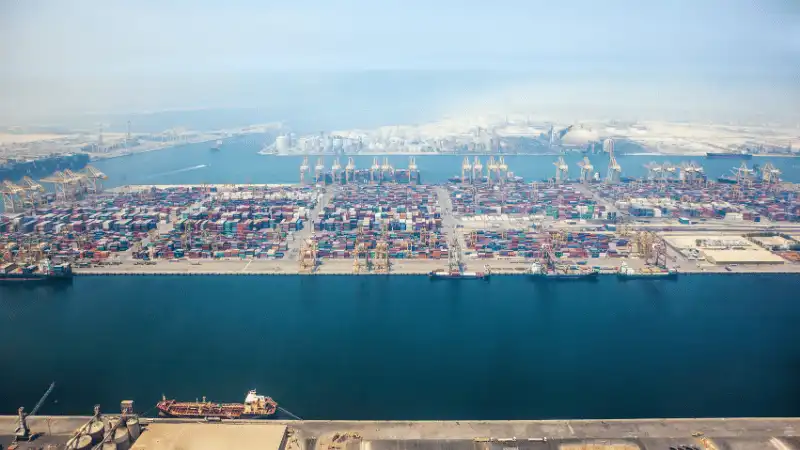
The Port of Jebel Ali in the United Arab Emirates is the busiest port in the Middle East, handling 13,970,000 TEU in 2023. Located in Dubai, Jebel Ali is one of the largest and most advanced ports in the world, serving as a major transshipment hub for cargo moving between Asia, Europe, and Africa. Its state-of-the-art infrastructure, deep-water berths, and extensive logistics facilities make it a critical gateway for trade in the region.
2. Tanger Med, Morocco
Tanger Med, with a throughput of 7,596,845 TEU, ranks second among the busiest ports in the Middle East. Located at the crossroads of major global shipping lanes, Tanger Med serves as a vital transshipment hub between Europe, Africa, and the Americas. Its rapid growth and strategic location near the Strait of Gibraltar have made it an essential link in global supply chains.
3. Jeddah, Saudi Arabia
The Port of Jeddah, with an annual volume of 4,960,120 TEU, is the third-busiest port in the Middle East. Situated on the Red Sea, Jeddah is the primary gateway for imports to Saudi Arabia and a critical transit point for cargo moving between Asia and Europe via the Suez Canal. Recent expansions and modernization efforts have enhanced its capacity and efficiency, making it a key player in regional trade.
4.Salalah, Oman
The Port of Salalah handled 4,504,000 TEU in 2023, ranking fourth in the region. Salalah is strategically positioned on the Arabian Sea, close to major shipping lanes between Asia and Europe. The port has become a significant transshipment hub due to its deep-water berths, efficient operations, and ability to handle the world’s largest container ships.
5. Khalifa Port (Abu Dhabi), UAE
Abu Dhabi’s Khalifa Port processed 4,330,000 TEU in 2023, making it the fifth-busiest port in the Middle East. The port's rapid development and investment in advanced technology and infrastructure have helped position it as a key logistics hub in the region, catering to both local and international trade demands.
6. Port Said, Egypt
Port Said, with a throughput of 4,252,979 TEU, ranks sixth among the busiest ports in the Middle East. Situated at the northern entrance of the Suez Canal, Port Said plays a vital role in global shipping, serving as a key transshipment and logistics hub for cargo moving between Europe and Asia.
Fastest Growing Ports in the Middle East and North Africa
Several ports in the Middle East are experiencing rapid growth due to strategic investments, infrastructure development, and increasing trade volumes.Jebel Aliremains the fastest-growing port in the region, driven by continuous expansions and its status as a global trade hub. The port’s investment in digitalization and automation has enhanced its operational efficiency, allowing it to handle larger volumes of cargo.
Tanger Medis another rapidly growing port, benefiting from its strategic location and ongoing expansion projects. It has attracted significant investment in infrastructure, allowing it to increase its capacity and become a major player in global trade. Its development has been supported by Morocco’s vision to position the port as a key logistics hub for Africa and beyond.